Showing posts with label India. Show all posts

Wednesday, 29 July 2009

Two Views of Rajasthan from the Train


Our only camera was a little Canon PowerShot SD1100, no bigger than a box of Altoids. It had its limitations, but it was capable of impressive clarity and agility. We're not professional, or even really amateur, photographers, so doing what we could do with the PowerShot was plenty for us. Anyway, it managed to pluck these two images of Rajasthan's countryside from the blur that raced along outside the window of our speeding train.

Saturday, 25 July 2009

Varieties of Travel Misery

A backpacker is a wretched creature. Your body dirty, your clothes rumpled, unfashionable, and smelly, you spend much of your time reduced to a primitive state of seeking out the basic necessities of survival: food, shelter, toilets. The language barrier renders you illiterate, and indeed barely able to communicate at the level of an articulate four-year-old, while you blunder about blithely violating customs, social norms, and basic rules of civility.

The locals, accustomed to the notion of rich Westerners, find you cheap and bewilderingly uncouth. Those who are more used to dealing with your type figure they have you pegged: what you want is to drink a lot of beer, listen to Bob Marley, and eat banana pancakes, in between being overcharged for taxi rides. Your fellow backpackers are mainly keen to impress upon you how much more intrepid they are than you, while your expat compatriots just find you embarrassing (though the feeling is very often mutual). Every so often you find yourself in your grubby hostel or third-class train carriage thinking wistfully of the mid-range comforts you could afford if you weren't trying to stretch your dollars through half a dozen different countries -- and if you happen to stumble into a high-end restaurant or a luxury hotel (maybe you're still looking for that toilet) the contrast, and the prices, make your head spin.

Of course it's not all bad. Of course your trip is filled with astonishing experiences and serendipitous pleasures; of course you can find all kinds of grounds to smugly pity the high-rolling tourists who will never have the experience of meeting the locals in the hard seat section of a Chinese train, or of the stark and simple joy you feel at the early morning appearance of a chai walla. And anyway, once you've been home a couple of months, all the bad parts begin to disappear from memory.

But sometimes things just suck. And in recognition of that simple fact, herewith I present three visions of travel misery for your schadenfruede-soaked pleasure.

1. Top Bunk Purgatory


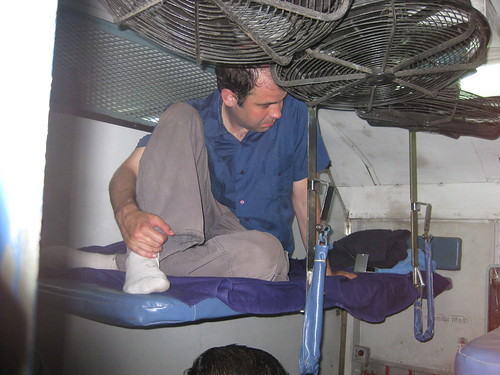
Jaisalmer-Delhi Express, India. Top berth in a sleeper class carriage. It was hot, cramped, and dirty, and the train was sitting motionless at the platform, our departure delayed indefinitely while the conductor banged away at a broken bunk with some sort of hammer. The fans weren't working. Rachel thought it would be a good time to take a picture of me.

2. Despair on a Train


As I mentioned above, traveling in hard seat class on a Chinese train is a great way to meet locals -- who are, it must be said, mostly solicitous and kind. It's also a great way to spend a night jammed upright among at least six other people, enveloped in a noxious cloud of cigarette smoke and the stench of un-flushed squat toilets, dodging the phlegm noisily hocked up and spat on the floor all around you, wishing for the comparative serenity of an Indian sleeper car.

This photo is actually slightly posed, though the sentiment was real. It was taken shortly after boarding, when we were starting to get an idea of what our night was going to be like, but before we were invited to take seats in what looked to us like a completely full compartment. I'll be bragging about the misery of that night for decades.

3. Washed Up in Likeng


Our first evening in Likeng, a tiny and painfully picturesque village in China's Jiangxi province, the owner of our guesthouse told us she was turning in early because she had to get up before dawn to slaughter the pig. Sure enough, we were awakened at three a.m. by the harrowing sounds of the deed being done ten feet directly below our window. In the morning there was blood on the rocks and a major butchering operation underway in the family's living quarters.

Likeng is a widely recognized historic village, under assault by waves of day trippers during holiday periods. It happened to be where we ended up parking ourselves during the May Day week, when, we were told, it would be foolish to try getting around or finding a hotel room anywhere in China. We stayed put in our simple room, with its hard beds, smelly squat toilet (yes, it's a theme in China), and wide variety of available pork-based dishes, venturing out to take pictures of the village or walk along the lovely path through a narrow agricultural valley surrounded by pine-wooded hills. For two days, it was charming. The third day, it began to get a bit old. The fourth day, it rained. We were confined to our guesthouse, sick of our books and our conversations, and totally fed up with the simple pleasures of the countryside. I spent much of the day on the balcony staring like an angry hunchback at a world I had come to loathe, no matter how beautiful it might be. While I was occupied with this, Rachel surreptitiously took my picture, capturing for posterity a moment of the impressive self-pity one can work up while enjoying the trip of a lifetime.

The Great Thar Desert: Dawn


The only clouds Jaisalmer had seen for a month hid the stars that night, and they muddled the dawn, but the dawn was beautiful nonetheless, bleeding in from behind the gray. The sand was combed by the wind and it picked up the uneven glow of the sky. I took a few pictures.


Sunday, 19 July 2009

Camel Safari Pictures: The Great Stinky Desert


So it turns out that camels fart constantly. During the whole of our two-day trek through the Great Thar Desert outside Jaisalmer, we were enveloped in a cloud of methane, much of which was generated from all the deposits left behind by other creatures on the desert floor, but to which our camels made prodigious contributions as we rode.

I'd heard that camels were uncomfortable to ride, but the abstract knowledge is nothing against the actual agony of the experience itself. You spend your first ten minutes on the back of a camel marveling at the view, the stilt-walking feel of the ride, and the comedy of the animal itself. You spend the rest of the time desperately looking forward to getting back down again.

We rode out through bean fields dried up for the summer, across a vast scrubby plain (stopping for a break at an atmospherically-abandoned village), to an isolated sand dune where we spent the night sleeping in the open air under a field of clouds that hid the spectacular stars we had been promised. We were cripplingly sore, the food was awful, the camels were surly, and there were scorpions in our blankets (okay, one scorpion). But, also, it was amazing.

The picture above, as well as the second and third photos below, are by Rachel.


More camel safari photos here.

North India Photo Highlights

Tombs of the Maharajas, outside Jaisalmer, India, at dawn

Rajasthan, Delhi, and the Taj Mahal...North India highlights from the Flickr page are here.

Saturday, 18 July 2009

South India Photo Highlights

Fishing boat at Chowpatty Beach, Mumbai


It's time to revisit this blog and finish out the posts - I'll start by pointing out that we've been getting the Flickr page organized. The next few posts will be links to the "highlights" photos for each country, which now feature captions for pretty much all the pictures (if you want to see more than that, feel free, but that makes you pretty hard-core...)

So, South India highlights are here.

Reblog this post [with Zemanta]

Saturday, 9 May 2009

Photos from Jaisalmer

Gateway to Jaisalmer Fort

Once again, here's a flashback to India - this is from late February...

Our last stop in Rajasthan was Jaisalmer, a desert outpost not far from the border with Pakistan (in an area bustling with military activity, especially given the heightened tensions around the time of our visit). Jaisalmer grew wealthy as a stopover for camel caravans en route between India and Persia, protected by a storybook castle rising out of the sands, inside of which narrow lanes are now filled with shops catering to the new nomads: travelers dropping in before heading further out into the desert on multi-day camel safaris (I'll describe our own trek in a separate post). Today the fort is crumbling and in need of funds for preservation and repair.

Jaisalmer Fort

Internet and vegetable vendors, Jaisalmer town - photo by Rachel.

Lane inside Jaisalmer Fort - photo by Rachel.

Tombs of the Maharajas, near Jaisalamer, sunrise.

Jaisalmer town, viewed from the fort.

More Jaisalmer photos here.

Today is our last day in China - we're heading out in a little while to see some of the Olympic architecture, adding a historical bookend to our visits to the Forbidden City and Great Wall. Tomorrow we fly to Tokyo to begin the last two weeks of our trip. I'll try to get as many photos online as possible during the next few days.

Wednesday, 6 May 2009

Jodhpur Photos

Mehrangarh Fort looming over Jodhpur's old city

So, as mentioned below, the India posts are flashbacks to an earlier phase of the trip. We arrived in Jodhpur in late February, making it a stopover before beginning the final leg of our travels through Rajasthan.

The city is astounding. Like the other cities we visited in Rajasthan, it was once the capital of a small kingdom - in this case Marwar, which is in fact the place whose name means "land of death" (below, I incorrectly attributed that meaning to Mewar, the area around Udaipur - sorry, it's been a couple of months...).

The dramatic name is derived from the fact that Jodhpur stands at the edge of the Great Thar Desert, which stretches out death-ishly to the west. The old city comprises a vast jumble of square blue houses, painted in the color traditionally associated with the homes of Brahmins (though these days, as the palace museum's audio guide disdainfully notes, "anyone can paint his house blue"). Lording over it all is Mehrangarh Fort, a massive citadel that must have brought stomach-churning despair to any potential attackers who laid eyes on it.

Jodhpur was typical of Rajasthan for us in that it was an extraordinary place to see - and it looks great in pictures - but also full of hassle and kind of an annoying place to actually be. At any rate, here are some pictures, presented hassle-free.

Another view of the fort

Jodhpur old city

The three pictures below are by Rachel.

Central market

Blue house, old city

The Omlette Shop near the Central market: best omlette I've ever had.

More Jodhpur photos here.

Saturday, 2 May 2009

Everybody Like Udaipur


The great fortress of Chittorgarh, stronghold of Mewar (whose name means "land of death")*, held against the forces of the Mughal Emperor Akbar for five months in 1567 and 1568, until finally there was nothing left for the fort's defenders but to perform the ancient and terrible act of jauhar - a final display of Rajput chivalry in which the men would don saffron robes and ride out to to their certain deaths at the hands of the enemy, while the women and children built a great fire and threw themselves on the flames.

One person who somehow managed to avoid the jauhar of 1568 was Mewar's ruler, Maharana Udai Singh, who instead escaped to found a new capital some miles further west. He called it Udaipur, and on a hill at its center he built a delightful new palace, which looks down on narrow, winding lanes in a delicate and whitewashed town, all of it reflected back again by the waters of Lake Pichola. "Everybody like Udaipur," said the autorickshaw driver who picked us up from the train station, and if the founding of the place was less than heroic, it's hard to argue with the city's charm. Udaipur is indeed easy to like, especially when viewed from one of the rooftop restaurants that populate the skyline, offering a great vantage point as the sunset tints the blue-and-whiteness of everything with a pale pink, while temple bells ring and the City Palace begins to glow. We only stayed a couple of days, but of course we took lots of pictures.

City Palace rising above Udaipur

Udaipur street scene

View from the "Monsoon Palace" overlooking Udaipur.

More Udaipur pictures here.

*OOPS - not true. Marwar is the land of death. Mewar apparently means "long wand" - make of it what you will.

Wednesday, 22 April 2009

Amber Fort

Painting the ceiling, womens' quarters, Amber Fort - pic by Rachel.

We're currently in Fenghuang, Hunan Province. I'm trying to upload some Hong Kong and China pix as I write - wish me luck. Meanwhile, another India flashback:

The most magnificent sight in the Jaipur area is Amber Fort, which had served as the seat of Amber state before the construction of Jaipur. It's a vast, sandstone stronghold spreading across the top of a bluff, impressive both for its defensive aspect and for its graceful Mughal-era style, combining elements of both Hindu and Muslim artistry. Walking around inside the fort, you can get pleasantly lost in the winding passageways and hidden chambers, especially in the mazelike womens' quarters. Emerging into the courtyards you see blazes of color - banners and saris - against the honey-colored stone. Here are a few pictures.


Mughal garden, Amber Fort courtyard


Mirror, Hall of Private Audiences, Amber Fort


Amber Fort photo set on our Flickr page is here.

Friday, 3 April 2009

Jaipur: Jantar Mantar


In between running a kingdom, founding a city, and commanding an imperial army, Jai Singh II managed to keep himself busy with astrological pursuits - overseeing the construction of five observatories scattered across northern India, of which the largest is in Jaipur. Visiting, you walk amongst fantastically big and odd-looking instruments designed to monitor the movements of the sun and the stars. We had a guide to explain the function of each of the (impressively sophisticated) devices, but I'm not sure I can remember everything he told us.

The concave structure above is actually half an instrument, separated to allow the court astronomers to walk in amongst its sections for better observation. Observation of what, I don't know.

I do know that the tower below is the world's largest sundial:

Massive Sundial


It's so precise that you can actually see the sun moving across it, counting the seconds. The actual dial part is a much larger version of the one pictured here (which served as a prototype):

Sundial


Here's me with a smaller sundail calibrated to track the progress of the astrological period for Leo - my sign:

Paul with Leo Dial


Finally, this wasn't actually in the observatory, but we thought this was a particularly well-dressed cow:

Holy Cow, Jaipur

Thursday, 2 April 2009

Jaipur: The Hawa Mahal

Hawa Mahal Colored Glass
Jaipur from behind purdah: view through colored glass at the Hawa Mahal

The Rajputs - Rajasthan's historic warrior clans - were fiercely Hindu, but culturally they were affected by centuries of contact with Muslim traders and invaders. One Muslim tradition the Rajputs adopted was purdah, the practice by which women were to be kept out of the sight of men. The women of Jaipur's court observed a strict form of purdah, which had the effect of isolating them from the life of the city.

Both to mitigate and to facilitate this isolation, Maharajah Sawaj Pratap Singh ordered the construction in 1799 of the Hawa Mahal, a palace whose primary purpose was to serve as a sort of pink sandstone veil for the royal women. It's a virtually flat, five-story high building, an elegantly carved screen full of tiny windows, behind which the court women would sit to observe the action on the streets below. Here are a few pictures - the photo above, which is one of my favorites, is by Rachel, as is the last one below.

paul pics 025

paul pics 034

paul pics 030