Showing posts with label China. Show all posts

Saturday, 25 July 2009

Varieties of Travel Misery

A backpacker is a wretched creature. Your body dirty, your clothes rumpled, unfashionable, and smelly, you spend much of your time reduced to a primitive state of seeking out the basic necessities of survival: food, shelter, toilets. The language barrier renders you illiterate, and indeed barely able to communicate at the level of an articulate four-year-old, while you blunder about blithely violating customs, social norms, and basic rules of civility.

The locals, accustomed to the notion of rich Westerners, find you cheap and bewilderingly uncouth. Those who are more used to dealing with your type figure they have you pegged: what you want is to drink a lot of beer, listen to Bob Marley, and eat banana pancakes, in between being overcharged for taxi rides. Your fellow backpackers are mainly keen to impress upon you how much more intrepid they are than you, while your expat compatriots just find you embarrassing (though the feeling is very often mutual). Every so often you find yourself in your grubby hostel or third-class train carriage thinking wistfully of the mid-range comforts you could afford if you weren't trying to stretch your dollars through half a dozen different countries -- and if you happen to stumble into a high-end restaurant or a luxury hotel (maybe you're still looking for that toilet) the contrast, and the prices, make your head spin.

Of course it's not all bad. Of course your trip is filled with astonishing experiences and serendipitous pleasures; of course you can find all kinds of grounds to smugly pity the high-rolling tourists who will never have the experience of meeting the locals in the hard seat section of a Chinese train, or of the stark and simple joy you feel at the early morning appearance of a chai walla. And anyway, once you've been home a couple of months, all the bad parts begin to disappear from memory.

But sometimes things just suck. And in recognition of that simple fact, herewith I present three visions of travel misery for your schadenfruede-soaked pleasure.

1. Top Bunk Purgatory
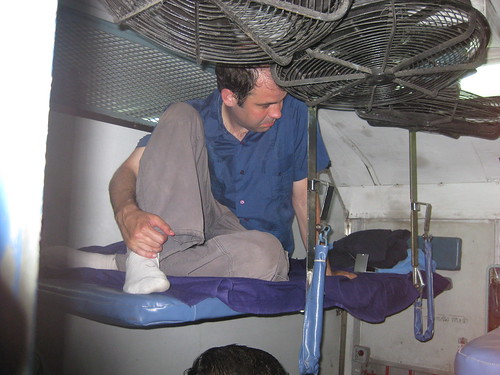

Jaisalmer-Delhi Express, India. Top berth in a sleeper class carriage. It was hot, cramped, and dirty, and the train was sitting motionless at the platform, our departure delayed indefinitely while the conductor banged away at a broken bunk with some sort of hammer. The fans weren't working. Rachel thought it would be a good time to take a picture of me.

2. Despair on a Train


As I mentioned above, traveling in hard seat class on a Chinese train is a great way to meet locals -- who are, it must be said, mostly solicitous and kind. It's also a great way to spend a night jammed upright among at least six other people, enveloped in a noxious cloud of cigarette smoke and the stench of un-flushed squat toilets, dodging the phlegm noisily hocked up and spat on the floor all around you, wishing for the comparative serenity of an Indian sleeper car.

This photo is actually slightly posed, though the sentiment was real. It was taken shortly after boarding, when we were starting to get an idea of what our night was going to be like, but before we were invited to take seats in what looked to us like a completely full compartment. I'll be bragging about the misery of that night for decades.

3. Washed Up in Likeng


Our first evening in Likeng, a tiny and painfully picturesque village in China's Jiangxi province, the owner of our guesthouse told us she was turning in early because she had to get up before dawn to slaughter the pig. Sure enough, we were awakened at three a.m. by the harrowing sounds of the deed being done ten feet directly below our window. In the morning there was blood on the rocks and a major butchering operation underway in the family's living quarters.

Likeng is a widely recognized historic village, under assault by waves of day trippers during holiday periods. It happened to be where we ended up parking ourselves during the May Day week, when, we were told, it would be foolish to try getting around or finding a hotel room anywhere in China. We stayed put in our simple room, with its hard beds, smelly squat toilet (yes, it's a theme in China), and wide variety of available pork-based dishes, venturing out to take pictures of the village or walk along the lovely path through a narrow agricultural valley surrounded by pine-wooded hills. For two days, it was charming. The third day, it began to get a bit old. The fourth day, it rained. We were confined to our guesthouse, sick of our books and our conversations, and totally fed up with the simple pleasures of the countryside. I spent much of the day on the balcony staring like an angry hunchback at a world I had come to loathe, no matter how beautiful it might be. While I was occupied with this, Rachel surreptitiously took my picture, capturing for posterity a moment of the impressive self-pity one can work up while enjoying the trip of a lifetime.

Friday, 8 May 2009

Entering China: Guangzhou

Swimming in the Pearl River, Guangzhou. Not for the chemical-sensitive.

I mentioned a little bit about Guangzhou's history in a previous post. Over the centuries it has served as one of the main (and, sometimes, one of the only) gateways for foreigners visiting China. A short drive up the Guang-Shen Expressway from Hong Kong, it continues to be a popular first stop for international tourists like us.

It certainly makes for an easy landing. We had a nice room at the Riverside International Youth Hostel (YHA: the secret to successful budget travel in China), right by the Pearl River on a street full of outdoor bars and restaurants. Just across the river was the old foreign concession on Shamian Island, with leafy car-free streets lined by French and British colonial architecture. Beyond Shamian stretches a big and vibrant city with beautiful parks and great historical sights, from the ancient through the 20th century. Getting around is easy, too, on the city's brand-new, shiny metro - which turns out to be in many respects a copy of Shanghai's system.

I'm sounding like a spokesman for the Guangzhou Booster Committee. The place was just nicer and more user-friendly than I was expecting, and we ended up staying an extra night, taking the city as a place worth seeing in its own right as opposed to just a stopover. A little bit of Guangzhou came with us when we left: our next two destinations were filled with tourists from the city and its surrounding province.

Neon sign right outside our hostel (but thankfully not outside our window), Baietan Bar Street.

Waiters lined up to receive their daily briefing, Shamian Island. We saw this at a number of places, and I couldn't help wondering if it was a holdover from the old danwei work-unit system. But I don't really know. Photo by Rachel.

Cargo by the river. Pic by Rachel.

Bust of a young Mao, Peasant Movement Institute. Guangzhou was the shared base of the Kuomintang (Nationalist) Party and the Communists during their brief period of cooperation in the early 1920s. The Communists, including Mao and Zhou Enlai, used a former Confucian temple as a place to train cadres. Now it's a museum, fairly interesting despite the lack of English captions on most of the exhibits.

More Guangzhou photos here.

More from Hong Kong

Grouchy cat, near the Mid-Levels Escalator, Hong Kong. Pic by Rachel.

In some not-quite-tangible sense, Hong Kong felt big the way New York feels big. It's something about the combination of wealth, grand physical presence, and grittiness. As noted below, by night it's actually a more impressive sight than NYC. By day it's pretty cool, too. Here are a few more pictures.


Above: minibuses and apartments in Kowloon.

Shoppers at the Goldfish Market, Kowloon.

Girl on a bike, Victoria Park, Hong Kong Island.


We're currently in Beijing, our last stop in China before flying to Tokyo. We arrived this morning after a marvelously comfortable overnight journey in a soft-sleeper class high speed train. Spent the day biking around the city, which was great but which has left us extremely grimy and with bloodshot eyes and sore throats from the pollution. Tomorrow: the Great Wall.

Thursday, 7 May 2009

Chinglish, Part 2

Maybe these are funnier when you actually see them instead of reading about them on a blog but I can't resist posting this updaded list of hilarious English translations we've come across in the last week or so.

Names of shops:
Monopolying Shop of Tree Rock Carving and Jade Article
Satisfied Ornament
Thousand Predetermined
Eminent Frog Porridge and Soup Company Limited

Item on a menu:
North Peasant Family with Boiler
Dumpling with Ovary and Intestines of Crad

On a packet of almonds:
Absolutely You Cannot Resist This Palatable Food

Road signs:
Do Not Drive Tiredly
Climbing Section Driving Prudently

And my favorite, this sign alerting us to a pedestrian ramp at a bus station:
Caution Landslide!

Wednesday, 6 May 2009

Shanghai Would Like You to Buy a Watch

The first time I visited New York was in 1989. I was 13 years old, on a student tour group seeing the sights and taking in Broadway musicals. We spent a lot of time wandering around an unreformed, pre-Disney Times Square, for which we were carefully prepped: instructed, among other things, not to engage with the shady characters selling fake Rolexes out of black briefcases on the sidewalk. One of our group's members, a slightly older girl named Angie, took the message very seriously, and when I happened to cast a glance over my shoulder at one of the hawkers, barked out an anxious reprimand: "DON'T LOOK AT THEM!"

New York used to be a place with a worldwide reputation for parting rubes from their money - from the thieves and swindlers of the 19th century to the Three-Card-Monty dealers of the 1980s, the city was traditionally flush with dangers for visiting bumpkins, immigrants, sailors, and other first-timers. I mention this because it's funny to note that Shanghai seems to be carrying on the tradition, at least in a more modest form. Of course, Shanghai was famous for waylaying people as well - the city's name became a notorious verb; what goes on now isn't anything as bad, but it's notable for having more hustle and hassle than other places we've been in China. It ranges from the merely annoying (the constant badgering by fake-watch vendors) to the infuriating (the $5 haircut that balloons to $40 when a handful of "conditioner" is thrown in), to the criminal (the common tea festival scam, which was tried on us - unsucessfully, I should add - by a trio of seemingly-friendly young "tourists from Shenzhen").

It hasn't seriously damaged our impression of Shanghai - pissed off as I was about the haircut - which is a really pleasant and fascinating city. But if Shanghai had been our first stop in China, rather than our second-to-last, we might have developed a level of cynicism about interacting with people that would have been unfair to the many honest and kind people we've met elsewhere in this country. But I guess that's just the big city for you...

UPDATE: After I wrote this post, Rachel and I walked down East Nanjing Road to People's Square, where two more groups of clean-cut youngsters tried to strike up conversations in textbook tea festival scam-style. Apparently People's Square is a notorious staging point for this swindle, but it's quite striking to see how common it is.

Monday, 4 May 2009

Hong Kong by Night


Chinese cities look good at night. Even the provincial towns, we've noticed, are often glamorous, bathed in neon and digital light shows, with giant glowing Chinese characters cutting the darkness. Neon, sadly a near-dead form in New York City these days (Times Square notwithstanding), is still popular here.

The glitziest of all is Hong Kong. We first saw Hong Kong by night, and we were struck by how atmospheric it was - the dramatic landscape and architecture looming in shadows while the lights bring bright colors to the streets. Here's a sample (the second-from-last and third-from-last pics are by Rachel).


The very best sight - one of the best things I've ever seen - is the view of Hong Kong from Victoria Peak at night. Sadly, our fantastic little camera couldn't really capture the scene, but here's a good picture from Wikipedia.

More of our own Hong Kong photos here.

Saturday, 25 April 2009

Report from "the Real China"

I'm posting this from the Yangtze River International Youth Hostel in Chongqing, China, which had taken on something of a holy grail status during the seemingly unending and ridiculously complex journey we undertook to get here. Two days ago, we were finishing a pleasant three-night stay in Fenghuang, a beautiful Ming/Qing dynasty-era river town in Hunan province. Fenghuang has only just made its debut in the Lonely Planet, so while it is crowded with Chinese tourists, we saw fewer than half a dozen Western visitors during our time there.

Our next destination was to be Chongqing, starting point for Yangtze River cruises through the Three Gorges. Following the advice of a couple of helpful hotel staffers, we got up early on Friday morning to catch a bus to nearby Tongren, from which we expected to begin - at about 11:00 am - a seven-hour train journey to Chongqing. In Tongren, however, we were confronted with the dreaded "mei you" - often the only words in a sentence that foreigners can understand, and while what can be understood is that "mei you" means "don't have," we have no idea why what we want to have cannot be had, or whether it can be had a little later, or somewhere else, or for a different price, or in another form. All we knew was we were in Tongren, a provincial Chinese town unmentioned in the guidebook, blindly following the advice of people we had met two days and thirty miles previously, and our plan had run aground because when we stumbled through the Mandarin phrases required to book tickets to Chongqing, we were met with "mei you."

Eventually we learned that a landslide had closed a key tunnel on the tracks to Chongqing, which made as much sense as any other explanation. Meanwhile, we stumbled around from train station to long-distance bus station to short-distance bus station, from Tongren to Jishou to Huaihua, eventually ending up in sleeper berths on a train that was claimed to be heading for Chongqing: departing Friday night at 22:38, arriving Saturday morning at 06:00.

Twenty four hours after that, we were sitting in our crowded sleeper carriage, motionless on the tracks about two miles from the Chongqing station, while a passenger revolt began to break out around us. Our train had taken an alternate route to bypass the landslide, arriving in the Chongqing area several hours late, only to find that no platform was available in the Chongqing station. For two hours we sat on one siding outside the city, watching the sun set. Then we rolled forward maybe a mile, to sit for another two hours on yet another siding. The train was out of water and food, and the carriages filled with cigarette smoke as we waited. Some passengers argued with railway staff, demanding to be let off - and a few escaped through windows, hustling down the tracks on foot, luggage in hand, smiling and waving to the cheering crowds still imprisoned on the trains (another train full of delayed passengers was stuck just across from us).

Rachel and I waited it out, and finally, at 11:00 pm, more than 24 hours since we had boarded the train in Huaihua, and about 36 hours since we had begun our (supposedly eight-hour) journey, we pulled in to disembark at Chongqing. We took a room at the first hotel we found near the station, an efficient operation busy funneling in late-arrivers, and spewing out early-departers in the morning.

This morning, after a confusing pair of taxi rides and a bit of lost wandering around, we managed to find the Yangtze River Hostel, which we had booked for two nights previously. We're not staying here now, but we had heard it was a good place to book Three Gorges trips, and it is - the staff here are fantastic (and not at all angry about our no-show).

All along the way, we've been joking about being lost in the "real China" - readers of this blog might know how much terms like that annoy me. For the 48 hours it took us to to get here, we've been the only Westerners in sight, and, with a near-absolute language barrier, we've mostly had only a dim idea, if any, of what was going on at any particular time.

The point of it all - the over-long journey, this over-long post - is that we really would have been lost were it not for the unbroken chain of kindness with which we were met by the people we encountered along the way. I don't like to generalize about vast cultures - "the Chinese are X" - but I do have to say that at every turn we've found people willing to go out of their way to help lost foreigners, even if we don't have any language in common: telling us which bus station to try; explaining to cab drivers where to take us; the woman who took us on a city bus to the Jishou train station (almost certainly not where she herself was planning to go) on a rainy afternoon, and then tried to give us her umbrella; the travel agent in Jishou who went to the ticket counter with us to help us book our tickets (for no fee); two young women on the overnight train who spoke a little English and gave us periodic updates on stituation.

The real China, insofar as we've seen it over the past couple of days, seems to be bustling, and very very big. It's also, I'm happy to say, full of very decent people.

Thursday, 16 April 2009

Chinglish


Judging by the number of hilarious English translations of signs we've seen in the few short days that we've been in China, Chinglish may have to become a regular installment on the blog. Here are a few of our favorites so far.

A sign on the wall at the immigration port read "Please do not shake my head so that I may serve more of your heads." (Then, at the border control desk itself, we were invited to "assess the performance of your inspector" by pressing one of three buttons marked "perfect," "ok," and "unsatisfied," somewhat undermining the all-powerful air that immigration officials are supposed to assume. I wondered, if my inspector had rejected my visa and banned me from entering the country, whether I could have changed his mind by pressing the "unsatisfied" button. Luckily I didn't have to try.)

A sign on the door of a toilet cubicle at the immigration port instructed the occupant to "please keep cleaning."

Another sign on a toilet door read "Male; Man."

A notice outside a doctor's office in Guangzhou reassured potential patients that "We cure your pain and care about the health of your Spondyle."

And then there was the German beer ad promising a "naive feeling derived in germany," which we thought sounded more like a crossword clue than anything else.

As for our Chinese language skills, we're attempting to learn a couple of basic Mandarin words but were in Cantonese speaking places for the first few days so haven't had much chance to try it out yet. As a result, ordering lunch the other day consisted of pointing to what the people at the next table were eating and hoping it didn't turn out to be cat.

Wednesday, 15 April 2009

Pearl River Sunset

Shenzhen Expressway 1

Shenzhen Expressway 2

Shenzhen Expressway 3
Shenzhen Expressway sunset

Guangzhou, our first stop in China, was known to the west for centuries as Canton - the first and for a very long time the most important Chinese port city to be open for foreign trade. Since the Beijing government began its post-Mao economic reform, it has returned to that role, from its site at the heart of the Pearl River Delta (PRD) open economic area.

A vast proportion of the "foreign" direct investment in China in fact comes from Hong Kong, Taiwan, and the overseas Chinese diaspora. The PRD open area was set up to benefit from Hong Kong investment, and it has - it is the richest and most developed area of China, rivalled only by the Yangtze river delta area around Shanghai. Within the PRD, the city of Shenzhen - just across the border from Hong Kong - was set up as a Special Economic Zone with even greater investment incentives, and in the last three decades Shenzhen has gone from being a small fishing village to one of the largest and richest cities in China, with a population equal in size to New York's.

As we made the two-hour trip up the (Hong Kong-financed) expressway from Shenzhen to Guangzhou, we travelled through the most industrial landscape I've ever seen - a continuous expanse of factories and workers' housing, covered in a thick layer of pollution tinted pink and orange by the sunset and set aglow by the occasional neon sign (in fact we haven't seen blue sky since we left Singapore). When you read that something is "Made in China," chances are it's made here.

We're taking a night bus to Guilin tonight, which should be a somewhat different experience. In the meantime I'll see if I can bring some order to our Flickr page.

Tuesday, 14 April 2009

Quick Update from Guangzhou

After three nights in Hong Kong, today is our first morning in China 'proper' - we're in the southern port city of Guangzhou, and very excited to be here. Will post more as soon as possible, and after we've had a chance to sort out some of the Flickr uploads we've done recently. Hong Kong was amazing, by the way.

Thursday, 9 April 2009

Singapore: Looking Ahead

Buddha contemplating the Port of Singapore

So we're in Singapore, which seems in many ways to be exactly what people say it is - wealthy, expensive, sparkling clean, frighteningly orderly, and very well policed. The definitive Singaporean social contract is supposedly that its people have traded a certain number of civil liberties for law and order and the highest material standard of living in Southeast Asia, and one can certainly see that contract in effect. Still, it's a friendly enough place, and surprisingly green, particularly outside its surprisingly small city center; moreover, I have to admit it's a real pleasure to be in a place where everything works, and where one can stroll around enjoying a vibrant outdoor nightlife without the slightest worry about crime. Also, the Singapore Zoo's Night Safari is freaking awesome.

Singapore's founder and towering political figure Lee Kuan Yew (now the country's "Minister Mentor") apparently gave a talk just yesterday, outlining his take on the city-state's overall strategic, economic, and social situation. He stressed the benefits to Singapore of its multi-racial identity and its nimble diplomacy, both of which have helped it secure its position in the world. Notably, he repeatedly emphasized Singapore's "meritocracy" in places where American politicians would talk about their country's "democracy." I don't pretend to know anything really about Singapore, but I thought it was interesting.

So, having stayed in Singapore just long enough to reinforce some stereotypes - for better or for worse - we're flying off to Hong Kong tomorrow (April 11), then crossing into mainland China via Guangzhou on April 14.

I'm not entirely sure about the internet situation in China - as is well known, the Chinese government censors many websites (I've read that about 10% of all websites are unavailable in China). Evidently, Blogspot is periodically one of those, but I'm not sure if that's currently the case, and of course it's impossible to predict what might happen. Moreover, even finding internet cafes may be difficult in places where the government has cracked down.

Nonetheless, we'll try as much as we can to keep posting updates, and to maintain our Flickr page, which will include a new section for highlights of the China trip, as well as individual sets for the various destinations. If we can't use Blogger, we'll try to post updates via Flickr and/or Facebook.

At any rate, we're incredibly excited about the coming leg of the journey, and cramming to learn some essential Mandarin before we go (sounding entirely ridiculous as we try to guess how the language's tones are supposed to work). Will post more as soon as possible.